

Table of Contents
- The Role of Rarity in Crystal Pricing
- How Color Intensity and Clarity Drive Cost
- Factors Affecting Gemstone Value: Cut, Carat, and Origin
- The Hidden Costs of Ethical Sourcing and Labor
- How to Identify Fake Crystals and Treated Stones
- Market Demand, Artificial Scarcity, and Investment Value
- Metaphysical Properties vs. Market Value: What You're Really Paying For
- Conclusion: Why Natural Crystals Are Expensive and Worth It
- Frequently Asked Questions
Last Updated: September 11, 2026
The Role of Rarity in Crystal Pricing
Natural crystals expensive pricing starts with rarity, which sets the floor price, and everything else layers on top of it. A mineral that forms in only a handful of locations worldwide carries a built-in premium before color, clarity, or cut even enter the conversation (usgs.gov).
This is where most buyers get tripped up. They assume "natural" automatically means "valuable." It doesn't. Common quartz is abundant and affordable. Rare specimens from collapsed localities or depleted deposits are a different story entirely. To understand why natural crystals are expensive, you have to start with geology, not marketing.
Consider why certain minerals command high prices:
- Restricted geological formation, Some crystals require precise temperature, pressure, and chemical conditions that exist in very few places on Earth
- Depleted deposits, When a mine stops producing, existing specimens become finite and prices climb
- Difficulty of extraction, Crystals embedded in hard rock or found deep underground cost more to recover
- Color rarity, A mineral that's common in white but rare in deep blue will always price the blue higher
At CrystalCloud Company, we offer ethically sourced and verified crystals. The rarity isn't manufactured; it's geological.
How Color Intensity and Clarity Drive Cost
Color intensity and clarity are the two most visible pricing levers in the crystal market. A stone with vivid, saturated hue and minimal internal inclusions can command several times the price of a pale, cloudy specimen of the same mineral.
Gemologists evaluate color across three dimensions: hue (the actual color), saturation (how vivid or intense it is), and tone (how light or dark). A deeply saturated stone with medium tone sits in the sweet spot that collectors and jewelers pay premium for. Clarity works the same way. Inclusions, fractures, and cloudy zones reduce both aesthetic appeal and structural integrity.
Here's the practical reality: two amethyst points from the same mine can differ dramatically in price based on nothing more than color depth and how clean the interior looks under light. This is why photographs rarely tell the full story. The same stone can look rich in one lighting condition and washed out in another.
Clarity matters most for jewelry-grade material, where a single visible inclusion can drop the value significantly. For raw specimens and decorative pieces, some inclusions are expected and even desirable. Knowing which category you're buying into changes what you should pay.
Factors Affecting Gemstone Value: Cut, Carat, and Origin
Factors affecting gemstone value come down to four pillars: cut quality, carat weight, geographic origin, and overall condition. Each one shifts the final price, and together they explain most of the variation you see between similar-looking stones.
Cut quality determines how light moves through a finished stone. A precise facet arrangement maximizes brilliance and color return. Poor cutting wastes rough material and produces a dull result, which drags value down even when the raw crystal was exceptional. Cut is also where skilled labor costs enter the equation. Precision faceting takes hours of trained work.
Carat weight follows a simple principle: larger natural crystals are exponentially rarer. A clean specimen at ten carats isn't just twice as valuable as a five-carat one (gia.edu). It can be many times more, because the probability of finding a flawless large crystal drops sharply as size increases.
Geographic origin and provenance carry real weight. Stones from historic or well-documented localities often sell at a premium because collectors value the story and the verified source. Mining difficulty varies enormously by region, and that cost gets passed through the supply chain.
| Value Factor | What It Measures | Why It Raises Price |
|---|---|---|
| Cut quality | Facet precision, light return | Skilled labor, less wasted rough |
| Carat weight | Size of the crystal | Larger flawless stones are exponentially rarer |
| Origin | Locality and provenance | Mining difficulty, collector demand |
| Condition | Inclusions, fractures, damage | Cleaner stones grade higher |
The Hidden Costs of Ethical Sourcing and Labor
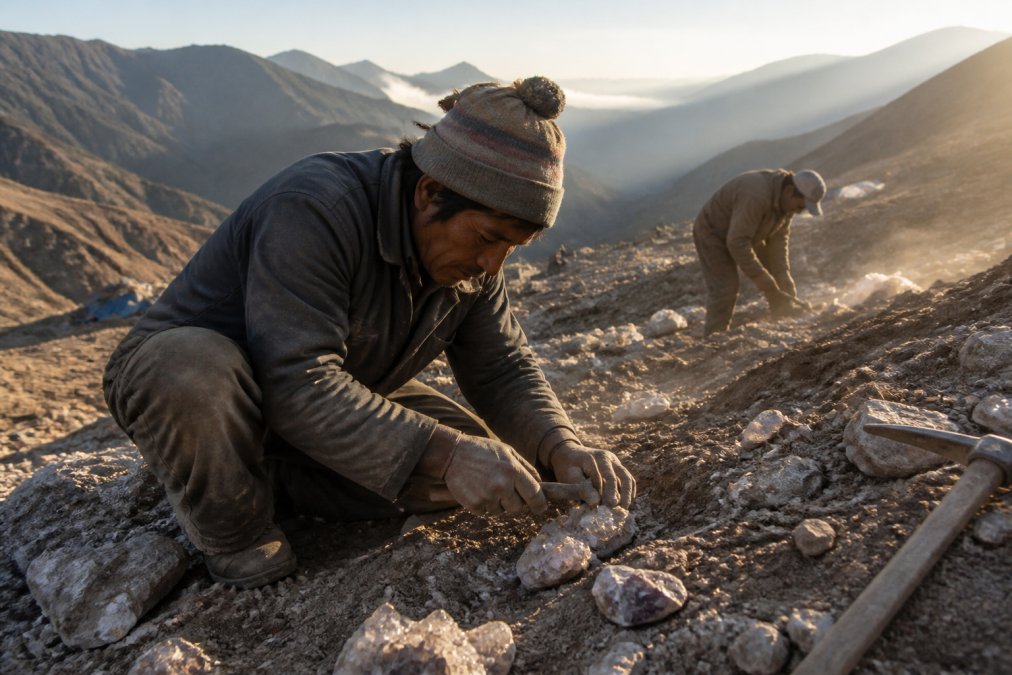
Ethical sourcing adds real cost that cheap crystal listings quietly skip, and the reason is structural: most of the world's crystal supply moves through informal, artisanal, and small-scale mining (ASM) rather than large industrial operations. ASM is labor-intensive by definition. When miners are paid fairly, given safety equipment, and aren't relying on child labor, the cost per stone rises. That's not a markup. It's the actual cost of doing business responsibly.
The U.S. Department of Labor maintains lists of goods and countries where child labor or forced labor is known or suspected in extraction, and gemstones and mineral specimens appear on those lists for several producing regions. U.S. Department of Labor reports on child labor and forced labor in global supply chains That's the baseline reality a buyer is stepping into. A seller who can't trace a stone past a wholesaler is almost certainly not paying the premium that ethical extraction requires.
Where the money actually goes
- Fair wages and safe conditions. Hand extraction of specimens from hard rock is slow, dangerous work. Paying a living wage, providing ventilation, and covering injury risk all raise the per-stone cost before the stone ever leaves the ground.
- Traceability and documentation. Chain-of-custody paperwork, mine-level records, and third-party audits cost money to produce and maintain. A stone with a verifiable origin has passed through more checks than one that hasn't.
- Certification and grading. Independent labs charge per-stone fees for identification and treatment disclosure. That cost is baked into any certified specimen.
- Post-extraction processing. Cleaning, sorting, grading, and in some cases stabilizing or trimming add labor hours. A raw specimen that arrives display-ready has already absorbed that labor.
- Compliance and legal overhead. Import documentation, customs, and compliance with U.S. laws such as the Lacey Act (which prohibits trafficking in illegally sourced plants, wildlife, and certain regulated materials) add administrative cost that informal sellers avoid.
A useful mental model: the price difference between a suspiciously cheap stone and a fairly priced one is often the difference between a supply chain that can be documented and one that can't. You are not paying for a sticker. You are paying for the paper trail behind it.
This is the part of the price most guides skip entirely. They explain rarity and color and stop. But for a large share of the market, the human and compliance cost of getting a stone out of the ground legally and fairly is a bigger line item than most buyers realize.
How to Identify Fake Crystals and Treated Stones
Learning how to identify fake crystals protects both your wallet and your trust. The market is full of dyed glass, reconstituted material, and natural stones that have been altered through heat treatment or irradiation to fake a more valuable color.
Start with these checks:
- Temperature, Real crystals feel noticeably cool to the touch and warm slowly in your hand; glass warms quickly
- Weight, Many genuine minerals are denser than glass of the same size
- Inclusions, Natural stones usually show internal flaws, bubbles, or growth lines; perfectly uniform glass often has round air bubbles
- Color, Dyed stones often have color concentrated in cracks and fractures rather than distributed evenly
- Price, If a flawless, deeply colored specimen costs a fraction of market rate, something is wrong
Treatments aren't always dishonest, but they must be disclosed. Heat treatment is common and sometimes acceptable when stated clearly. Undisclosed dyeing or irradiation is a different matter. Reputable sellers test and certify their stones, and they'll tell you plainly whether a piece has been treated.
Market Demand, Artificial Scarcity, and Investment Value
Market demand drives crystal prices as much as geology does, and that's where things get complicated. When a mineral trends on social media, demand spikes faster than supply can respond. Prices climb. Then they often fall just as quickly once the trend fades.
But here's the mechanism most guides leave out: for common minerals, the supply was never actually scarce. What changes is attention. A mineral that is geologically abundant, like clear quartz or amethyst, can still see retail prices jump when a trend pushes thousands of new buyers into the market at once. The mines don't run out. The middle of the supply chain just reprices what it already has.
How artificial scarcity actually works
- Withholding stock. A dealer holds back inventory and releases it slowly to create the impression of limited supply, even when more exists in storage.
- Framing language. Terms like "rare find," "last one," and "mine closed" get applied to minerals that are neither rare nor from closed mines. Genuine scarcity comes from depleted deposits and restricted geological formation. Manufactured scarcity comes from marketing copy.
- Trend amplification. A single viral post can move a mineral from obscurity to sold-out in weeks. Resellers then raise prices to match the new demand, and the higher price itself becomes a signal that the stone is "valuable."
- Grade inflation. Specimens get relabeled as higher grade than they are, so a mid-tier stone sells at a top-tier price during the hype window.
The tell is timing. If a mineral was affordable and widely available two years ago and is suddenly "almost gone" at triple the price, the scarcity is likely manufactured, not geological.
Investment-grade vs. decorative crystals
This is the distinction that separates two completely different markets sharing the same storefront.
| Buyer Type | What They're Buying | Price Driver | Resale Reality |
|---|---|---|---|
| Collector | Rare, documented specimens | Provenance, scarcity | Holds value if documentation is solid |
| Investor | Certified, high-grade stones | Verifiable rarity, demand stability | Depends on a liquid secondary market |
| Decor buyer | Aesthetic statement pieces | Appearance, size, trend | Usually resells at a fraction of retail |
| Beginner | Starter kits and everyday stones | Accessibility, guidance | Not an investment; buy for use |
Investment value depends on verifiable rarity, certification, and stable long-term demand. A museum-quality specimen with documented provenance can hold or grow in value. A trendy tumbled stone bought at peak hype usually won't, because the demand that inflated it was temporary and the supply was never constrained.
The honest takeaway: most crystals sold today are decorative or personal, not investments. That's fine. The mistake is paying investment prices for decorative material because a trend made it feel rare. Know which market you're actually buying into before you spend.
Metaphysical Properties vs. Market Value: What You're Really Paying For
Metaphysical properties and market value are two separate systems, and conflating them leads to bad purchases. A stone's metaphysical properties speak to intention, energy work, and personal meaning. Its market value comes from rarity, clarity, color, cut, and origin. Neither one determines the other.
This is the honest truth most crystal sellers avoid: a stone can be deeply meaningful to you and still be worth very little on the open market. And a stone can be extremely valuable and mean nothing to you energetically. Both are fine. The mistake is paying investment prices for decorative material, or expecting a budget stone to hold resale value.
What you're really paying for when you buy from a trustworthy source is a combination of factors: genuine material, verified authenticity, ethical sourcing, and curation that matches the stone to its purpose. At CrystalCloud Company, we choose specimens with intention, whether that's a rare collector piece or a beginner-friendly kit.
Conclusion: Why Natural Crystals Are Expensive and Worth It
The reasons natural crystals expensive prices trace back to geology, labor, and verification, not arbitrary markups. Rarity sets the foundation. Color, clarity, cut, and carat weight build on it. Ethical sourcing, certification, and post-extraction processing add costs that cheap listings hide. And market demand, for better or worse, moves the whole picture.
If you want stones you can trust, sourced with care, and chosen to match your intentions, that's exactly what we do. CrystalCloud Company offers ethically sourced and verified crystals, curated collections built around intention, and expert guidance on crystal rituals and pairing, from rare specimens to beginner-friendly kits. Explore the Collection and find pieces that earn their place in your space.
Frequently Asked Questions
Are natural crystals worth money?
Yes, natural crystals hold value based on rarity, clarity, color intensity, and provenance. Investment-grade specimens with strong color saturation and minimal inclusions can appreciate over time, while decorative crystals hold aesthetic and metaphysical value. The key is understanding factors affecting gemstone value before buying. Authenticity and ethical sourcing also influence resale potential, especially as demand for verified, untreated stones grows among collectors.
How do I tell if a crystal is real?
Start by examining for internal flaws: natural crystals often have inclusions, bubbles, or uneven color, while fakes like dyed glass appear too perfect. Check weight and temperature; real stones feel cool and dense. Use a magnifying glass to look for air bubbles (a sign of glass) or uniform dye lines. Request certification or provenance documentation when buying. If a crystal is suspiciously cheap or flawless, it's likely synthetic or treated.
Does the size of a crystal affect its price?
Yes, carat weight and physical size directly impact price, but not linearly. Larger natural crystals are rarer, especially with good clarity and color, so prices can jump exponentially. A 10-carat clean specimen may cost far more than twice a 5-carat one. However, a large but heavily included or pale stone may be less valuable than a smaller, gem-quality piece. Size matters most when combined with rarity and aesthetic appeal.
How does ethical sourcing impact crystal costs?
Ethical sourcing raises costs because it ensures fair wages, safe working conditions, and environmental protections. Verified supply chains require documentation, third-party audits, and traceability from mine to market. These processes add overhead that cheap, unregulated sources avoid. When you buy ethically sourced crystals, you're paying for labor dignity, reduced environmental harm, and authenticity. This transparency is why ethically sourced stones often cost more than mass-market alternatives.