

Table of Contents
- Why Intentional Crystal Care Matters More Than the Crystal Itself
- How to Cleanse New Crystals Before Their First Use
- Crystals That Cannot Go in Water: A Safety Checklist
- How Often to Cleanse Crystals Based on How You Use Them
- How to Set Intentions With Crystals for Lasting Focus
- Daily Use, Storage, and Display for Your Collection
- Troubleshooting: When Your Crystal Feels Heavy or Dull
- Your First Week of Intentional Crystal Care
- Frequently Asked Questions
Last Updated: September 6, 2026
Why Intentional Crystal Care Matters More Than the Crystal Itself
Intentional crystal care is the practice of cleansing, charging, and programming your stones so they remain clear tools for your energy work.
Most guides treat cleansing as an optional chore. In practice, it is the foundation that makes everything else possible. A stone that has absorbed ambient energy from shipping, handling, and previous environments carries that clutter into your space. Smithsonian Institution's mineralogy resources explains that crystals form under immense pressure over millions of years, and that geological history is part of what makes them powerful anchors for human intention.
How to Cleanse New Crystals Before Their First Use
Cleansing new crystals should happen before you do anything else with them, including setting intentions. Every stone you receive has passed through multiple hands, warehouses, and environments before reaching you.
Begin by holding the stone under lukewarm running water for thirty to sixty seconds if it is water-safe, then pat it dry with a clean cloth. For stones that cannot tolerate water, move directly to smoke, sound, or earth methods.
Smudging, Sound, and Earth: Safe Methods for Every Stone
Smudging with sage, palo santo, or incense is the most versatile cleansing method because it works for every crystal type. Pass the stone through the smoke several times while stating your intention to clear it, such as "I release all previous energy from this stone."
Sound cleansing uses singing bowls, bells, or tuning forks to vibrate away stagnant energy. A few minutes of sound near your crystals accomplishes the same clearing without any physical contact. Earth cleansing involves burying stones in dry soil for twenty-four hours, which naturally grounds and resets their energy.
The US Geological Survey maintains educational resources on mineral properties that help beginners understand why different stones respond differently to cleansing methods, which brings us to a critical safety point.
Crystals That Cannot Go in Water: A Safety Checklist
Many popular crystals dissolve, crack, or fade when exposed to water, and this is where most beginners accidentally damage their collections. The rule is simple: when in doubt, use smoke or sound instead of water.
The minerals that must never touch water include selenite, which is water-soluble and can literally dissolve, and halite, which is salt. Malachite contains copper and can release toxic compounds when wet. Fluorite and calcite are soft stones that can crack or lose their polish. Pyrite, often called fool's gold, rusts when exposed to moisture. Mindat.org's mineral database on hardness and solubility provides detailed technical data on which minerals react poorly to water.
A quick reference table will help you keep your collection safe:
| Crystal Type | Water Safe? | Best Cleansing Method | Key Warning |
|---|---|---|---|
| Selenite | No | Smudging, sound | Dissolves in water |
| Malachite | No | Smudging, earth | Toxic when wet |
| Fluorite | No | Sound, smudging | Cracks or dulls |
| Rose Quartz | Yes | Water, moonlight | Avoid harsh soap |
| Clear Quartz | Yes | Water, moonlight, earth | Safe in most methods |
| Amethyst | Yes | Water, moonlight | Fades in direct sun |
How Often to Cleanse Crystals Based on How You Use Them
There is no universal schedule for crystal cleansing, but there are sensible guidelines based on energetic exposure and physical handling.
Energetic Exposure and Your Cleansing Rhythm
Crystals used daily for meditation, worn as jewelry, or kept in high-traffic areas need cleansing at least once per week. Stones that sit on an altar or shelf and are handled only during specific rituals can go two to four weeks between cleansings. Crystals used during intense emotional work or healing practices should be cleansed immediately after each use.
The physical environment matters just as much as the energetic one. A stone kept in direct sunlight will fade faster than one stored in a drawer, amethyst and rose quartz are particularly prone to color loss. A crystal carried in a pocket or worn against the skin picks up body oils, lotions, and sweat.
The 'Heavy' or 'Dull' Signal: When to Cleanse Immediately
You will also know when cleansing is needed by paying attention to the stone's feel. A stone that suddenly feels heavy, dull, or unresponsive has absorbed more than it can process.
Most practitioners describe this as a subtle shift: the stone may feel denser, its usual tingle or warmth may be absent, or it may look less vibrant.
The Deeper Cleanse Protocol
A quick smudge or sound bath often clears surface-level energetic residue, but a stone that feels persistently heavy may need a more thorough reset:
-
Physical cleaning first. Wipe the stone with a soft, dry microfiber cloth to remove dust, oils, and any physical residue. For water-safe stones, a brief rinse under lukewarm running water (30-60 seconds) followed by patting dry is sufficient. Do not use soap, it can leave a film that interferes with energetic resonance.
-
Full-spectrum energetic cleanse. Combine two methods rather than relying on one. For example, pass the stone through sage or palo santo smoke, then place it on a selenite slab or in a bowl of dry brown rice overnight. The smoke clears active energy; the selenite or rice provides a longer, grounding reset.
-
Rest period. After cleansing, let the stone sit undisturbed for 24 hours before reprogramming it with a new intention. This 'rest' period allows the crystal's internal structure to settle after the energetic release. Placing it in a dark, quiet space, like a cloth-lined drawer or a closed wooden box, supports this process.
-
Re-test. After the rest period, hold the stone in your dominant hand and notice how it feels. If it still feels heavy or dull, repeat the full-spectrum cleanse. If the heaviness persists after two or three deep cleanses, the stone may have absorbed something it cannot fully release on its own.
When to Retire a Crystal
Some stones absorb energies they cannot fully release, no matter how thorough your cleansing routine. This is more common with porous stones like howlite, or with crystals used for intense emotional or physical healing work. If a crystal continues to feel heavy after multiple deep cleanses, consider retiring it from active use.
Retirement does not mean disposal. You can bury the stone in dry earth for a full lunar cycle (about 29 days) to allow it to discharge naturally, then reintroduce it if it feels lighter.
How to Set Intentions With Crystals for Lasting Focus
Setting intentions with crystals transforms a pretty stone into a focused tool for manifestation and spiritual growth.
Hold the crystal in your dominant hand, close your eyes, and state your intention clearly and positively in the present tense.
Programming Your Stone: A Simple Ritual
Begin by sitting comfortably with your cleansed crystal in both hands. Take three deep breaths to center yourself. State your intention aloud, phrasing it as an already-existing reality rather than a future wish. Instead of "I want to find peace," say "I am peaceful and grounded."
Visualize the intention flowing from your heart, through your arms, and into the crystal. Hold this visualization for several minutes until it feels complete. Finish by thanking the stone and placing it somewhere you will see it daily, so the intention stays active in your awareness.
For beginners learning how to set intentions with crystals, consistency matters more than complexity. A simple ritual repeated daily for a week will program a stone more effectively than an elaborate ceremony performed once.
Daily Use, Storage, and Display for Your Collection
Your crystals deserve a home that honors their purpose and keeps their energy clear, but storage and display are also about physical preservation.
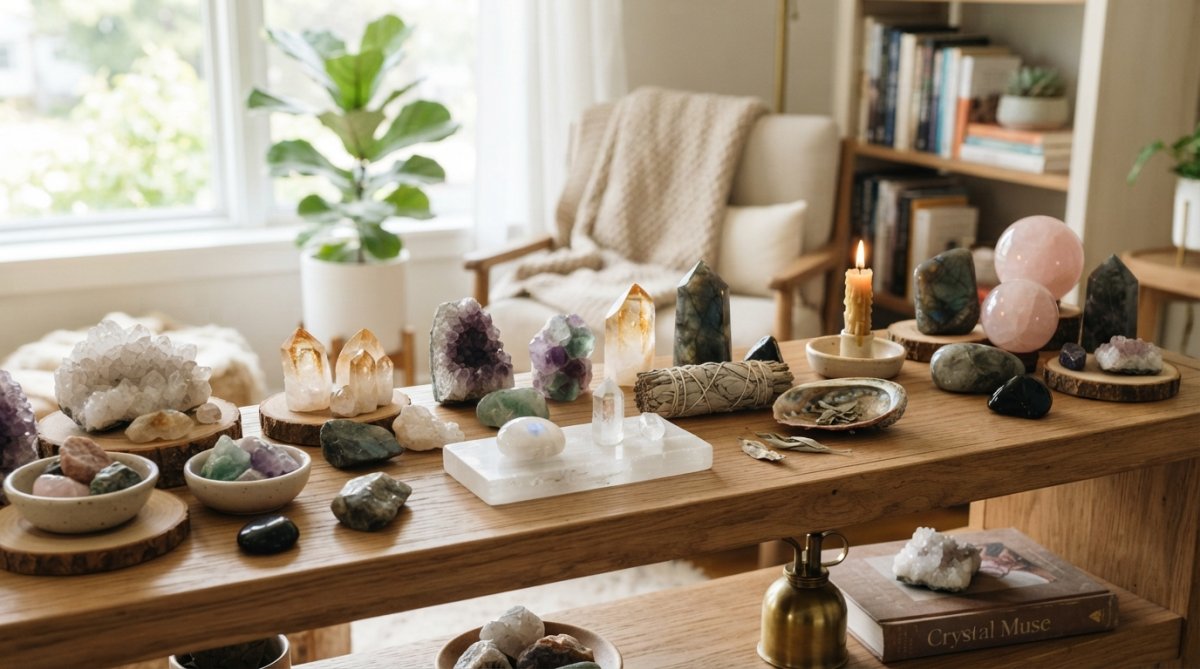
The Mohs Hardness Scale: Your Storage Cheat Sheet
The Mohs hardness scale, developed by German geologist Friedrich Mohs in 1812, ranks minerals from 1 (talc) to 10 (diamond).
A simple rule: never store crystals of significantly different hardness together in the same dish or bag. Softer stones (Mohs 1-3) will be scratched by harder ones (Mohs 7+) with even light contact.
Here is a practical hardness guide for common beginner crystals:
| Crystal | Mohs Hardness | Storage Note |
|---|---|---|
| Selenite | 2 | Store alone or with other soft stones; scratches easily |
| Calcite | 3 | Store separately; dissolves in acid and scratches easily |
| Fluorite | 4 | Store separately; chips and cracks easily |
| Malachite | 3.5-4 | Store separately; porous and reacts to water |
| Rose Quartz | 7 | Safe with most stones; avoid direct sun |
| Clear Quartz | 7 | Safe with most stones; very durable |
| Amethyst | 7 | Safe with most stones; fades in direct sun |
| Citrine | 7 | Safe with most stones; avoid prolonged sun |
| Pyrite | 6-6.5 | Store in a dry place; rusts in humidity |
Light, Humidity, and Temperature: The Invisible Enemies
Direct sunlight is the most common cause of crystal fading. Amethyst, rose quartz, citrine, and fluorite all lose color intensity when exposed to prolonged UV light.
Humidity is another silent threat. Pyrite oxidizes and rusts when exposed to moisture; malachite can develop a dull patina; selenite can literally dissolve. Store these stones in a dry area, away from bathrooms, kitchens, or damp basements.
Storage Solutions That Protect Both Energy and Structure
A dedicated storage system prevents physical damage and keeps energetic programming clear. Here are practical options ranked by protection level:
-
Individual cloth pouches, Best for soft stones (Mohs 1-4) or stones with delicate surfaces. Velvet, cotton, or muslin pouches prevent scratching and dust accumulation. Label each pouch with the stone's name and intention.
-
Compartmentalized wooden boxes, Ideal for medium collections. Look for boxes with individual felt-lined compartments or add your own felt dividers. Wood naturally regulates humidity better than plastic.
-
Felt-lined trays or dishes, Good for display, but only for stones of similar hardness. A single dish of mixed tumbled stones (all Mohs 6-7) is fine; mixing selenite with quartz is not.
-
Selenite charging plates, Selenite plates make excellent natural charging and cleansing stations, so placing frequently used stones on a selenite slab overnight keeps them ready for daily use. However, remember that selenite is soft, do not stack other stones on top of it, and place the plate on a stable surface.
Displaying With Intention: Grouping by Purpose
Crystals meant for specific purposes should stay separate. A stone programmed for sleep should not share a dish with one programmed for focus. Grouping by intention prevents energetic cross-contamination.
Consider a three-tier display system:
- Active stones (used daily): Keep in a small dish or tray near your meditation spot or desk. These are your 'working' crystals.
- Charging stones (recently cleansed, awaiting programming): Place on a selenite plate or in a dedicated charging bowl.
- Resting stones (retired or between uses): Store in a closed wooden box or cloth pouch, away from active energy.
By applying the Mohs hardness scale, controlling light and humidity, and grouping by intention, you transform storage from an afterthought into a core pillar of intentional crystal care.
Troubleshooting: When Your Crystal Feels Heavy or Dull
Every collector eventually experiences a stone that suddenly feels wrong. It may feel heavier than usual, look dull despite recent cleansing, or fail to produce the familiar energetic resonance.
The first step is a thorough cleansing using a method your crystal tolerates. If smoke and sound do not resolve the heaviness, try leaving the stone in dry earth or moonlight overnight, or placing it on a selenite slab for twenty-four hours.
Your First Week of Intentional Crystal Care
Starting your practice does not require a large collection or elaborate rituals. One well-chosen stone, cleansed and programmed with clear intention, will teach you more than a dozen neglected crystals.
Cleanse it on day one using the appropriate method for that stone. Set your intention on day two. Carry it or keep it visible daily.
By day seven, you will have established a rhythm that can grow with your collection. When you are ready to expand, seek out stones from sources that prioritize ethical mining and authenticity. CrystalCloud Company offers ethically sourced crystals with rigorous authenticity testing, along with curated beginner kits that include guidance on cleansing, charging, and intention-setting rituals. Our small business based in Virginia selects each piece with intention, so you know your collection supports both your energy and responsible sourcing practices.
Frequently Asked Questions
How do you cleanse new crystals for the first time?
Start with a dry method like smudging with sage or palo santo, passing the stone through the smoke for 30 seconds. You can also place it on a selenite plate overnight or use sound from a singing bowl. Check if your crystal is water-safe before using running water. After cleansing, hold the stone and state your intention aloud to begin your intentional crystal care practice.
What is the difference between cleansing and charging crystals?
Cleansing removes stagnant or negative energy the crystal absorbed, while charging replenishes its vibrational frequency. Think of cleansing as washing a dish and charging as filling it with fresh food. Cleanse before charging. Charge crystals under moonlight, on a selenite plate, or in sunlight for short periods, since some stones fade with prolonged sun exposure.
How often should you cleanse your crystals?
Cleanse weekly if you use a crystal daily for meditation or carry it with you. For crystals used occasionally or kept as decor, cleanse monthly or after an intense emotional event. Always cleanse a new crystal when it arrives, and cleanse stones after they've been in a stressful environment or around illness. Trust your intuition, but weekly is a solid baseline.
Can all crystals be cleansed in water?
No. Many popular stones are porous or contain minerals that dissolve or rust. Selenite, halite, and malachite can dissolve or be damaged by water. Others like pyrite and hematite can rust. Calcite and fluorite are soft and may scratch or break. Check the Mohs hardness scale and water solubility before rinsing, and use dry cleansing methods for uncertain stones.
How do you set an intention for a new crystal?
Find a quiet space and hold the cleansed crystal in both hands. Close your eyes, take three deep breaths, and focus on a single goal, like calm, focus, or protection. State your intention clearly in the present tense, such as 'I am grounded and calm.' Spend two minutes visualizing that energy filling the stone. Repeat this ritual whenever you feel the connection fading.
Caring for crystals is a practice of attention, and attention is what transforms a stone into a companion on your spiritual journey. Start with one crystal, one cleansing method, and one clear intention. The rest will unfold naturally as you learn to listen to what your stones need. Explore the CrystalCloud Company collection and find the ethically sourced stone that will anchor your practice.