

Table of Contents
- Why Crystals Get Dyed and What It Means for You
- The Simple Acetone Test for Dyed Crystals
- Visual Signs of Artificial Color Concentration and Dye
- How to Test Crystal Authenticity at Home: Texture, Weight, and Temperature
- Signs of Heat-Treated Crystals vs. Natural Color
- Common Fake Crystals List: Varieties You Should Scrutinize
- Advanced Checks: UV Light, Magnification, and Matrix
- Conclusion: Trust Your Senses and Buy with Confidence
- Frequently Asked Questions
Last Updated: September 5, 2026
Why Crystals Get Dyed and What It Means for You
The market is flooded with stones artificially colored to mimic rare, high-value specimens. Dyeing is an enhancement meant to deceive the eye, not the spirit. When you purchase a crystal for meditation or energy work, the stone's natural mineralogy matters, and artificial color concentration disrupts that authentic connection.
At CrystalCloud Company, we rigorously test and certify every piece for authenticity before it reaches your altar or shelf. Dyed quartz is often passed off as amethyst, citrine, or even turquoise, and the practice is widespread enough that the Federal Trade Commission guidelines on gemstone disclosure require sellers to clearly label treated stones. The problem is that many online marketplaces ignore these rules, leaving buyers to guess whether their "rare" specimen is genuine or just glass with a bad dye job.
The Simple Acetone Test for Dyed Crystals
The most reliable at-home check for dye is the acetone test, which reveals surface coatings and artificial color in minutes. Acetone dissolves many dyes without damaging most natural stones. To avoid false positives or damaging your specimen, follow this precise procedure.
Step-by-Step Procedure
- Prepare Your Materials: Use pure acetone (available at most hardware stores as a nail polish remover). You will also need a white cotton swab, a soft white cloth, and a well-ventilated area. Avoid using colored swabs or cloths, as they can confuse the results.
- Test an Inconspicuous Area First: Before testing a visible spot, rub the swab on the base or back of the crystal. This ensures that if the stone is porous or has a fragile coating, you won't damage its most valuable surface.
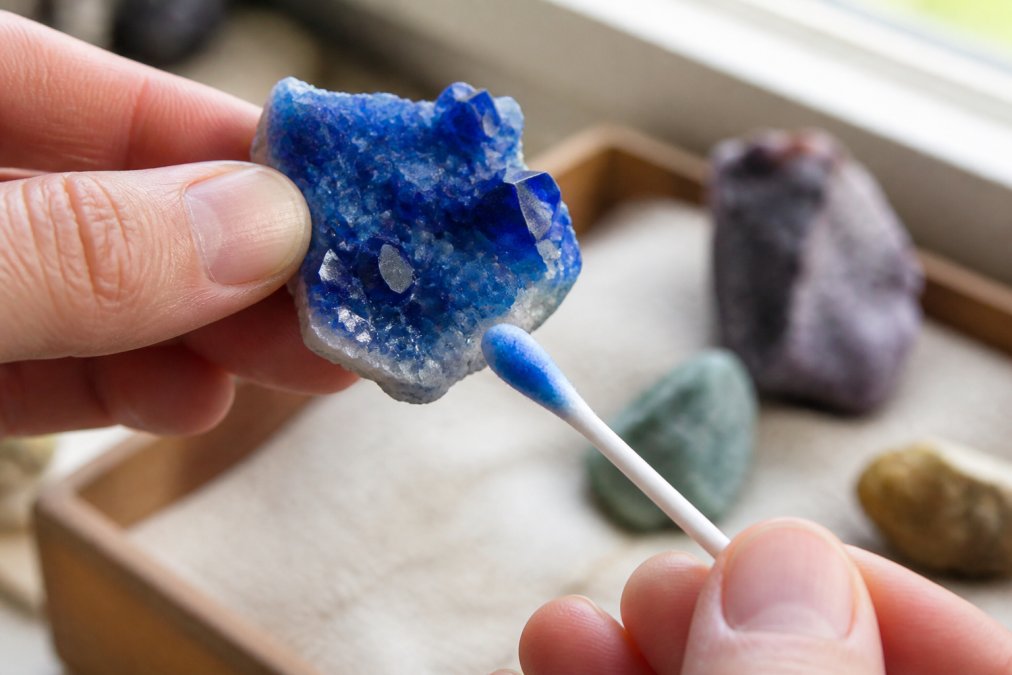
- Apply Firm, Consistent Pressure: Dip the swab in acetone and rub it firmly across the test area for about 10-15 seconds. Do not soak the stone; a damp swab is sufficient. The friction helps to break the surface tension of any dye or coating.
- Inspect the Swab Immediately: If any color transfers to the white swab, the crystal has been dyed. Natural stones will not bleed pigment under acetone. A faint residue of dirt or polish is normal, but a distinct color transfer is a definitive sign of enhancement.
- Focus on Fractures and Crevices: Dye often pools in fractures and crevices. After testing the main surface, use the swab to trace along any visible inclusions, cracks, or rough areas. This is where artificial color tends to concentrate, and it is the most common place to catch a dyed specimen that has a clear surface.
Safety and Material Limitations
Acetone is a powerful solvent. Always perform this test in a well-ventilated area, away from open flames, and wear gloves to protect your skin. Avoid this test on porous stones like turquoise, howlite, or opal, which can absorb the solvent and become damaged or discolored. For these stones, a visual inspection under magnification is a safer alternative.
Understanding False Negatives and Positives
A common mistake is testing only the polished surface. If the stone has been stabilized with a resin or polymer coating before dyeing, the acetone may not penetrate to the dye layer, resulting in a false negative. A slight sheen with no color indicates a coating, which is also a sign of enhancement. Conversely, some natural stones with high iron content can leave a faint orange or brown residue, which is not dye. Always compare the residue color to the stone's natural color; a true dye bleed will be a vivid, saturated version of the stone's surface color.
Visual Signs of Artificial Color Concentration and Dye
Dyed crystals display telltale color patterns that natural stones never exhibit. Artificial dye pools in fractures, settles in crevices, and concentrates along the stone's surface rather than growing from within.
Look for color that gathers in tiny cracks or along the base of the crystal, creating dark, saturated lines that natural mineral growth would not produce. Natural color follows the stone's internal structure with subtle zoning and translucency. Dyed specimens often show an unnaturally uniform, vivid hue that lacks the depth and variation of authentic mineralization.
Another red flag is color that appears only on the surface while the interior remains pale or colorless. Check the stone's termination points and any chips or abrasions; if the exposed interior is dramatically lighter than the surface, you are likely holding a dyed specimen. Genuine stones carry their color throughout their structure.
How to Test Crystal Authenticity at Home: Texture, Weight, and Temperature
Testing crystal authenticity at home goes beyond visual inspection. Natural crystals feel cool to the touch and warm slowly in your hand, while glass and resin imitations adjust to room temperature quickly.
Weight is another reliable indicator. Most natural stones feel heavier than their size suggests, while resin fakes and dyed glass imitations feel noticeably lighter and hollow. Practice holding known genuine specimens so your hand builds a reference for authentic weight.
Texture also reveals the truth. Natural crystals often have subtle irregularities, tiny growth lines, and natural fractures that synthetic or dyed pieces lack. Run your fingers across the surface; genuine stones feel cool and slightly uneven, while resin fakes feel warm, smooth, and almost plastic-like. The Gemological Institute of America's guide to identifying treatments explains that surface texture and temperature provide valuable clues that complement visual testing.
Signs of Heat-Treated Crystals vs. Natural Color
Heat treatment is a legitimate enhancement that alters a crystal's color permanently. Unlike surface dyes, it affects the entire stone, so the acetone test will not reveal it.
The most common example is citrine. Natural citrine is a pale, smoky yellow, while heat-treated amethyst produces a bright, saturated orange that collectors call "burnt amethyst." Heat-treated stones often show a telltale white or cloudy base where the color fades abruptly, whereas natural color transitions gradually throughout the crystal.
Heat-treated crystals are not fake, but they are enhanced, and ethical sellers disclose this treatment. The International Gem Society's overview of crystal enhancements notes that disclosure is the industry standard for transparency. When a seller cannot confirm whether a stone is natural or heat-treated, that silence is itself a warning sign.
Common Fake Crystals List: Varieties You Should Scrutinize
Certain crystal varieties are dyed so frequently that they deserve extra scrutiny before purchase. Knowing which stones are commonly targeted helps you focus your testing energy where it matters most.
| Crystal Variety | Common Fake | How to Spot It |
|---|---|---|
| Citrine | Heat-treated amethyst | Burnt orange color, white cloudy base |
| Turquoise | Dyed howlite | Acetone bleed, gray matrix lines |
| Amethyst | Dyed quartz or glass | Uniform vivid color, acetone bleed |
| Rose Quartz | Dyed glass | Air bubbles, no natural fractures |
| Lapis Lazuli | Dyed magnesite | Color pools in cracks, low density |
Howlite dyed blue is the most common turquoise counterfeit, appearing in jewelry and decor everywhere. Genuine turquoise has a distinctive matrix of brown or black veining, while dyed howlite shows gray, web-like patterns that lack authentic depth. Similarly, "crackle quartz" is often dyed to create colorful, fractured stones that are beautiful but not natural.
Advanced Checks: UV Light, Magnification, and Matrix
When your eyes and hands raise questions, gemological tools provide definitive answers. A professional-grade inspection using UV light and magnification can reveal the subtle fingerprints of artificial enhancement that are invisible to the naked eye.
The UV Light Test: Beyond Simple Fluorescence
A long-wave UV flashlight (365nm) is an inexpensive tool that can distinguish between many natural stones and their synthetic or dyed look-alikes. The test is not about whether a stone fluoresces, but how it fluoresces.
- Resin and Polymer Coatings: Many dyed stones are coated with a clear resin to seal the color and add shine. Under UV light, these resins often fluoresce a bright, chalky blue or white, creating a uniform glow across the entire surface. Natural, uncoated stones typically show a more muted or patchy fluorescence, if any.
- Synthetic Dyes: Certain organic dyes used to color stones will fluoresce under UV light, producing a neon-like glow that is unnatural for minerals. For example, a dyed blue howlite may glow a bright, electric blue, whereas natural turquoise shows a dull, earthy brown or no fluorescence at all.
- Oil and Wax Enhancements: Some stones are treated with oil or wax to deepen their color. These substances often fluoresce a pale yellow or green under UV light. If you see this, the stone has been enhanced, even if it isn't dyed.
How to Perform the Test: In a dark room, hold the UV light a few inches from the stone. Observe the color and distribution of the fluorescence. Compare it to a known genuine specimen of the same mineral if you have one. A uniform, bright, or neon-like glow is a red flag.
Magnification: A Jeweler's Loupe Diagnostic
A 10x jeweler's loupe is your most powerful tool for spotting dye concentration. Under magnification, the difference between natural color and artificial dye becomes starkly obvious.
- Color Concentration in Fractures: Natural color grows from within the crystal structure. Dyed color is forced into the stone from the outside. Under a loupe, look for dark, saturated lines of color that follow a fracture or crack. This is the definitive signature of dye penetration. Natural stones may have inclusions, but they will not have color that is darker along a fracture than it is in the main body of the crystal.
- Surface Pooling: Look for areas where the color appears to sit on top of the stone, rather than being part of it. You might see tiny, irregular pools of pigment in surface pits or along the girdle (the edge where the crystal meets its base).
- The 'Candy Shell' Effect: Some dyed stones have a thin, intensely colored outer layer that fades abruptly to a pale or colorless interior. This is visible at any chip, abrasion, or the stone's base. The transition is sharp, not gradual like natural color zoning.
Matrix Analysis: The Geological Context
The matrix, or host rock attached to the specimen, offers a final, often-overlooked clue. Genuine crystals form in a specific geological environment, and their matrix reflects that.
- Natural Matrix Transition: On a genuine specimen, the matrix transitions naturally into the crystal. The boundary between the two is irregular, with the crystal appearing to grow out of the rock. You may see tiny, unpolished crystal points embedded in the matrix.
- Painted or Artificial Matrix: Fakes often have a matrix that is painted on to look authentic. Examine the boundary under magnification. If the 'matrix' has a uniform, painted texture, or if it appears to be glued on, the specimen is suspect. Dyed howlite passed off as turquoise often has a gray, web-like matrix that is actually the natural veining of the howlite, not the brown or black matrix of true turquoise.
This advanced diagnostic approach, combining UV fluorescence patterns, high-magnification inspection of fracture networks, and matrix analysis, is the same methodology used by professional gemologists. By mastering these checks, you move beyond simple suspicion and gain the ability to articulate why a stone is fake, which is the ultimate protection against online scams.
Conclusion: Trust Your Senses and Buy with Confidence
The skills to identify fake dyed crystals come down to observation, testing, and trusting your instincts. Acetone tests, visual inspection of color concentration, and attention to texture and weight will protect you from the most common counterfeits on the market.
When you buy from a seller who cannot verify a stone's origin or treatment history, you accept risk. CrystalCloud Company eliminates that uncertainty with ethically sourced, rigorously tested specimens. Every stone in our collection is verified for authenticity, so you can focus on the energy work rather than wondering if your crystal is real.
Explore the Collection and bring home crystals you can trust, stones that carry their natural color and energy from the earth to your space without artificial shortcuts.
Frequently Asked Questions
How to tell if a crystal has been dyed?
The most reliable home method is the acetone test. Dip a cotton swab in pure acetone and rub a small, inconspicuous area of the stone. If color transfers to the swab, the crystal has been dyed. Also look for color pooling in tiny fractures or crevices and an unnaturally uniform, vivid hue. Natural crystals show color variation, while dyed stones often have a single, saturated tone that doesn't occur in nature.
What crystals are most commonly dyed or faked?
Common fake crystals list includes howlite dyed to imitate turquoise, clear quartz or glass sold as citrine, and agate dyed in bright neon colors. Crackled quartz is often dyed to create 'aura' or 'sunset' effects. Natural stones like rose quartz and amethyst are less frequently dyed but can be heat-treated to change color. Always inspect porous stones, like howlite or magnesite, since they absorb dye easily.
Are heat-treated crystals considered fake?
Heat-treated crystals are not fake, but they are enhanced. This is a standard practice, especially for amethyst to create citrine or to deepen color. The key difference from dyeing is that heat treatment alters the crystal's internal structure permanently and doesn't add foreign color. A heat-treated stone is still that mineral; a dyed stone has artificial color added. Disclose treatments are a matter of ethical sourcing and transparency.
How do I know if my crystals are fake with a flashlight?
A flashlight helps reveal internal structure. Shine a bright light through the stone. Natural crystals often show inclusions, fractures, or slight color banding. Man-made glass will be perfectly clear or have uniform bubbles. Dyed quartz may show color concentrated in cracks, visible as dark lines when backlit. Also, check the luster; glass often has a glassy, high shine, while natural stones have a more subtle, waxy, or vitreous luster.