

Table of Contents
- What Is Heat Treatment in Crystals?
- Why Gemstones and Crystals Are Heat Treated
- How to Tell If a Crystal Is Fake or Heat Treated
- How to Use a Loupe to Inspect Crystals
- Natural vs Heat Treated Citrine: Key Differences
- Commonly Heat-Treated Gemstones and Crystals
- When to Seek Professional Gemological Laboratory Testing
- DIY Identification vs. Professional Verification
Last Updated: August 30, 2026
What Is Heat Treatment in Crystals?
Heat treatment is a thermal process applied to crystals and gemstones to alter or enhance their color, clarity, or optical properties. When crystals are exposed to controlled high temperatures, the heat causes changes within the crystal's lattice structure and shifts the distribution of trace elements responsible for color. This is one of the most common treatments in the gemstone industry, applied to everything from amethyst to sapphire to citrine.
The process is permanent. Once a crystal has been heat-treated, those internal changes remain stable indefinitely. Understanding heat treatment matters because it affects value, authenticity claims, and whether a stone matches the description you received. A naturally colored amethyst commands a different price than a heat-treated one. Ethical sourcing, something CrystalCloud Company prioritizes, includes transparency about whether stones have been treated.
Why Gemstones and Crystals Are Heat Treated
Heat treatment serves practical purposes in the gemstone trade. The primary reason is color enhancement. Many crystals emerge from the earth with muddy, pale, or undesirable coloring. Heat treatment can intensify weak colors, shift hues to more marketable shades, or remove unwanted color casts. A pale citrine becomes a rich golden yellow. An amethyst with brownish tones becomes a vivid purple.
A secondary reason is clarity improvement. Heat can cause certain types of inclusions to become less visible or shift within the crystal. For some gemstones, this clarity enhancement is a standard industry practice and widely accepted by consumers and collectors.
Cost is also a factor. Treating a lower-grade stone to enhance its appearance is cheaper than sourcing naturally perfect specimens. This allows retailers to offer more affordable options. However, this cost benefit should always come with disclosure. A responsible seller, like CrystalCloud Company, discloses treatment clearly so buyers understand what they're purchasing.
How to Tell If a Crystal Is Fake or Heat Treated
Visual Inspection Without Tools
Start with your naked eye under natural daylight, not artificial lighting. Place the stone on a white or neutral surface and examine it from multiple angles.
Heat-treated stones often display uniform color saturation throughout. Natural crystals typically show color zoning, areas of deeper and lighter color distributed unevenly within the stone. A natural amethyst often has color concentrated at one end or in bands, with lighter areas elsewhere. A heat-treated amethyst tends toward consistent, even coloring from top to bottom.
Look for heat halos, faint, concentric rings visible around inclusions when examined closely. Heat halos form because heat treatment causes stress patterns in the crystal lattice around internal fractures or mineral inclusions. They're a strong indicator of heat treatment.
Check the base of the crystal if it's a point or terminated specimen. Heat-treated stones sometimes show a slightly different color at the base, indicating uneven treatment or the boundary between treated and untreated zones.
Natural crystals often have subtler, more complex color distribution. The color may shift slightly as you rotate the stone, a property called pleochroism. Heat-treated stones tend to show more uniform color that doesn't shift as much with angle.
Color Zoning and Heat Halos
Color zoning is one of the most reliable visual indicators of a natural, untreated crystal. In natural amethyst, you'll often see deep purple concentrated at the pointed end, fading to lighter purple or nearly colorless toward the base. This zoning reflects how the crystal grew in the earth and how iron impurities distributed themselves during formation.
Heat treatment disrupts this natural pattern. The high temperature causes color to redistribute throughout the crystal more evenly. A heat-treated amethyst will show much more consistent purple throughout, without the dramatic fade from dark to light.
Heat halos are microscopic stress patterns that appear as concentric rings around inclusions. They form because heat causes the crystal lattice to expand and contract, creating tiny stress zones around defects. Under magnification, these halos look like faint rings surrounding a visible inclusion or fracture. They're almost never present in untreated crystals.
To spot heat halos, you need magnification. A jeweler's loupe at 10x magnification will reveal them if present. Look around any visible inclusions, fractures, or cloudy areas. If you see concentric rings or a glowing halo effect, heat treatment is likely.
How to Use a Loupe to Inspect Crystals
Choosing the Right Magnification
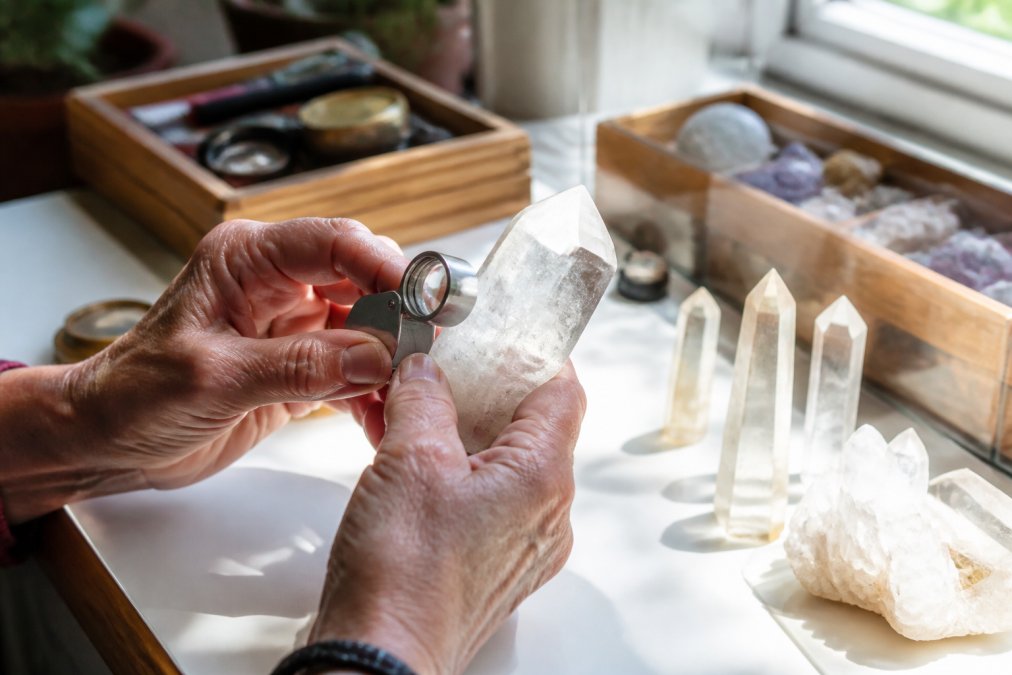
A jeweler's loupe is an essential tool for identifying heat treated crystals. The standard is a 10x magnification loupe, which magnifies the stone 10 times its actual size. At 10x, you can see enough detail to spot heat halos, color zoning boundaries, and internal fractures without magnifying so much that the field of view becomes too narrow.
A handheld loupe is portable and affordable. A loupe with a built-in LED light is more useful because internal features are easier to see with proper illumination. Avoid loupes with magnification higher than 20x for general crystal inspection. At 40x or 50x, the field of view shrinks too much. For identifying heat treatment, 10x is ideal.
The loupe should have good optical quality. Reputable manufacturers like Bausch & Lomb or Zeiss make loupes worth the investment. A decent 10x loupe costs between $15 and $50 and will last years if cared for properly.
What to Look For Under Magnification
Hold the crystal up to natural light or use a light source behind it. Look through the loupe at the interior of the stone. You're searching for three main things: heat halos, color zoning patterns, and internal fractures.
Heat halos appear as concentric rings around inclusions or fractures, like ripples in water. If you see these rings, the stone has almost certainly been heat-treated. Natural stones don't develop this pattern because they haven't experienced the thermal stress that creates it.
Color zoning under magnification should show a clear pattern if the stone is natural. You'll see distinct areas of deeper and lighter color, often following the crystal's growth planes. In heat-treated stones, the color appears more uniform under magnification. The color may still vary slightly, but it's more random and less organized than the structured zoning of a natural stone.
Look at the edges of any visible fractures. In heat-treated stones, fractures sometimes show a slightly different appearance than in untreated stones. Heat can cause fractures to heal partially or show stress patterns around them. Natural fractures tend to have cleaner, sharper edges.
Rotate the stone slowly while looking through the loupe. Watch how the internal features shift and change position. This helps you understand the three-dimensional structure of the stone and spot patterns that indicate treatment.
Natural vs Heat Treated Citrine: Key Differences
Citrine is one of the most commonly heat-treated crystals in the market. Natural citrine is rare (usgs.gov). Most citrine on the market is actually heat-treated amethyst or smoky quartz, transformed into the golden-yellow color that citrine is known for.
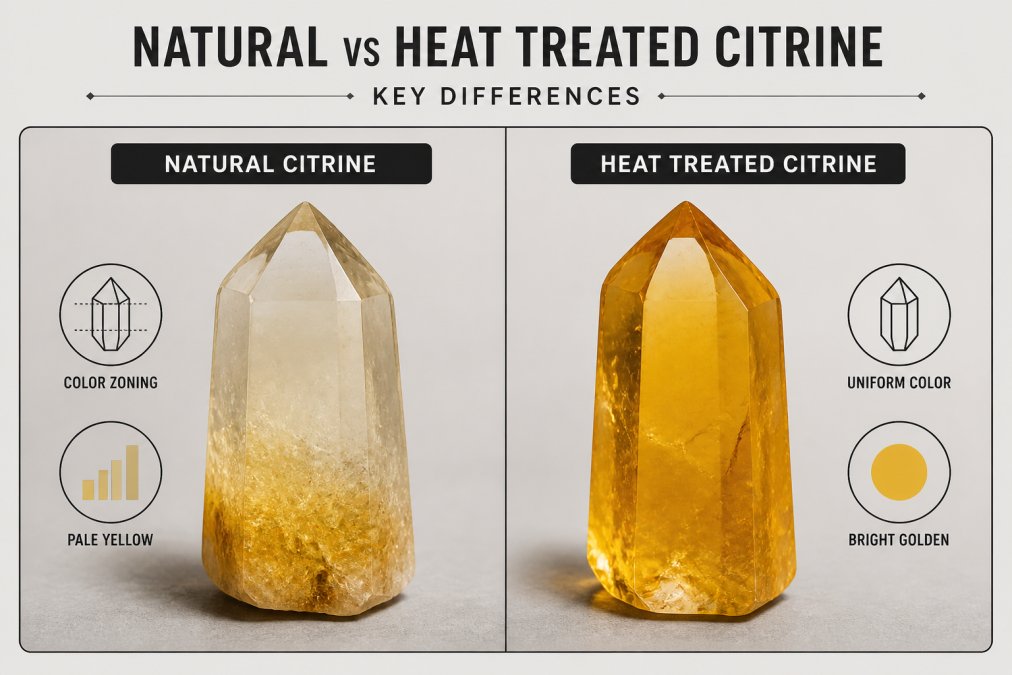
Natural citrine typically has a pale to medium yellow color, sometimes with a slight orange or brownish tint. The color is usually concentrated in certain areas rather than distributed evenly. Natural citrine often shows color zoning, darker yellow at one end fading to nearly colorless at the other.
Heat-treated citrine displays a vivid, bright golden or orange-yellow color that's uniform throughout the stone. The color saturation is intense and consistent from top to bottom. Heat-treated citrine often appears almost too perfect because it has been enhanced.
Under magnification, natural citrine may show subtle color variations and inclusions typical of the species. Heat-treated citrine often shows heat halos around any inclusions or fractures.
Price is another indicator. Natural citrine, being rarer, costs more per carat than heat-treated citrine. If a citrine is priced very affordably, it's likely heat-treated. This doesn't make it a bad purchase, heat-treated citrine is beautiful and legitimate, but it's important to know what you're buying.
CrystalCloud Company's citrine collection includes both natural and heat-treated specimens, clearly labeled so you know exactly what you're purchasing.
Commonly Heat-Treated Gemstones and Crystals
Heat treatment is standard practice for many popular gemstones. Nearly all commercial amethyst has been heat-treated to some degree to deepen the purple color or shift it toward a more desirable violet or blue tone (gia.edu).
Citrine is almost always heat-treated. Most citrine in the market started as amethyst or smoky quartz. Aquamarine is frequently heat-treated to intensify the blue color and improve clarity. Tanzanite is almost always heat-treated, typically mined in brownish or grayish tones and shifted to vivid blue and violet colors.
Tourmaline, particularly pink tourmaline, is often heat-treated to enhance color saturation and clarity. Ruby and sapphire, both varieties of corundum, are frequently heat-treated to improve color and reduce the visibility of inclusions. Topaz is commonly heat-treated, especially blue topaz, which is usually colorless topaz that has been irradiated and then heat-treated.
The key point is this: heat treatment is not a sign of poor quality or inauthenticity. It's a standard industry practice. What matters is disclosure. A reputable seller tells you whether a stone has been treated.
When to Seek Professional Gemological Laboratory Testing
Visual inspection and loupe examination are valuable skills, but they have limits. Sometimes you need professional confirmation, especially for significant purchases or when you want absolute certainty about authenticity.
A gemological laboratory performs tests that go far beyond what a loupe can reveal (gia.edu). They use spectroscopy, which analyzes how the stone interacts with different wavelengths of light to identify trace elements and reveal whether color is natural or the result of treatment. Laboratories also use microscopy at much higher magnifications, thermal imaging to detect heat treatment signatures, and other advanced techniques.
A certified gemologist has formal training in crystal and gemstone identification backed by years of years of study and hands-on experience.
Seek professional testing if you're purchasing a high-value stone. If you're spending more than a few hundred dollars, the cost of a laboratory certificate is worth it for peace of mind and documentation of authenticity. Professional certificates also matter if you ever want to resell the stone.
Many reputable sellers, including CrystalCloud Company, use gemological laboratory testing as part of their sourcing and verification process. When you buy from a seller who has already had stones tested and certified, you're getting that professional assurance built into your purchase.
DIY Identification vs. Professional Verification
There's real value in learning to identify heat treated crystals yourself. It's an engaging skill that helps you make better purchasing decisions and deepens your understanding of the stones you collect. With a loupe and some practice, you can spot many heat-treated stones and feel confident about what you're buying.
But DIY identification has real limits. A loupe won't definitively prove whether a stone is natural or treated in every case. Some heat-treated stones are done so skillfully that they're nearly impossible to distinguish from natural stones without laboratory equipment. Some natural stones have characteristics that mimic heat treatment indicators. Color zoning patterns can be ambiguous. Heat halos are clear when present, but their absence doesn't prove a stone is untreated.
Professional laboratory testing removes ambiguity. A gemological report tells you definitively whether a stone has been heat-treated and often provides additional information about its origin and optical properties.
The best approach combines both: use your DIY skills to get a sense of whether a stone might be treated and to ask the right questions of the seller. Then, for significant purchases or when you want absolute confirmation, get professional verification. Think of DIY identification as a screening tool that helps you make informed decisions, and professional testing as the final confirmation for pieces that matter most.
When buying from CrystalCloud Company, you're getting stones that have already been vetted for authenticity and treatment status. But if you want to develop your own identification skills for personal satisfaction or for evaluating stones from other sources, the techniques in this guide will serve you well.
Learning to identify heat treated crystals is a practical skill that serves you every time you evaluate a stone. Start with visual inspection under natural light, progress to using a loupe to spot heat halos and color zoning patterns, and know when to seek professional laboratory confirmation for high-value purchases. The combination of personal observation, hands-on examination, and professional verification when needed gives you the confidence to build a collection of authentic, ethically sourced stones that you truly understand. At CrystalCloud Company, we believe informed collectors make better choices, which is why we provide transparent information about treatment status and sourcing for every piece in our collection. Explore our verified, laboratory-tested stones and deepen your connection to the crystals that resonate with your intentions.
| Identification Method | Best For | Time Required | Reliability |
|---|---|---|---|
| Naked-eye visual inspection | Quick assessment, color zoning | 2-5 minutes | Moderate (good for obvious cases) |
| Loupe examination (10x magnification) | Heat halos, detailed structure | 5-10 minutes | High (with practice) |
| Professional lab testing | Definitive confirmation, high-value stones | 1-2 weeks | Very High (conclusive) |
| Spectroscopy analysis | Trace elements, treatment confirmation | Professional only | Very High |
| Thermal imaging | Heat treatment signatures | Professional only | Very High |
Frequently Asked Questions
How can I tell if a crystal is real or has been heat treated?
Real crystals show natural color variations, subtle internal fractures, and consistent optical properties under magnification. Heat-treated stones often display uniform color saturation, heat halos around inclusions, and color zoning patterns that appear too perfect. A jeweler's loupe reveals these differences. For definitive verification, a gemological laboratory can perform spectroscopy and other tests to confirm whether thermal enhancement has been applied.
What's the difference between natural and heat treated citrine?
Natural citrine displays color zoning with lighter and deeper areas, often with a smoky or champagne tone. Heat-treated citrine typically shows uniform, intense golden or orange coloring throughout, sometimes with visible heat halos around internal fractures and inclusions. Natural specimens may have more visible internal features and less saturated color. Heat-treated citrine is permanent but may be valued differently in the collector's market. Visual inspection with a loupe can identify these distinctions, though laboratory testing provides absolute confirmation of thermal enhancement.
Is heat treatment permanent, and does it affect a crystal's energy or durability?
Yes, heat treatment is a permanent alteration to the crystal's lattice structure. The thermal enhancement cannot be reversed. From a durability standpoint, properly heat-treated stones remain stable and suitable for jewelry and display. Some practitioners believe heat treatment may affect the energetic properties of crystals, though this remains subjective and not scientifically measurable. What matters most is disclosure: ethical sellers clearly state whether a crystal has undergone treatment so you can make an informed choice aligned with your intentions and values.
What should I look for when using a loupe to inspect crystals?
Use a 10x jeweler's loupe under bright light. Look for internal fractures, inclusions, color zoning, and heat halos, bright rings around bubbles or fractures indicating thermal treatment. Natural crystals show irregular color distribution and varied internal features. Heat-treated stones display uniform color, symmetrical heat patterns, and enhanced clarity in ways that look artificially perfected. Examine the stone from multiple angles.