

Table of Contents
- Why Fake Crystals Are So Common (And So Convincing)
- Physical Characteristics: What Real Crystals Look and Feel Like
- How to Test Crystals with a Flashlight (and UV Light)
- Temperature, Sound, and Thermal Conductivity Tests
- How to Spot Heat-Treated Crystals and Artificial Dyes
- Common Fake Crystals List: The Most Frequently Counterfeited Stones
- How to Identify Fake Crystals at the Microscopic Level
- Ethical Sourcing as an Authenticity Signal
Last Updated: August 24, 2026
Why Fake Crystals Are So Common (And So Convincing)
The crystal market has a counterfeiting problem most sellers won't discuss openly. Glass, resin, and dyed quartz are cheap to produce and photograph beautifully, yet many buyers discover they've been misled months later. Some treatments like heat processing are applied to real minerals, creating a gray zone where the stone isn't entirely fake but isn't authentic either.
The good news: real crystals follow consistent physical laws. Their formation leaves signatures that glass and resin cannot replicate. Once you know what those signatures look like, spotting imitations becomes reliable. Below are seven tests you can perform at home, plus two advanced methods worth knowing.
Physical Characteristics: What Real Crystals Look and Feel Like
Real crystals are imperfect by nature. Natural minerals grow over thousands or millions of years under pressure and heat, producing asymmetry, irregular surfaces, and internal features that synthetic imitations cannot replicate through molding or casting.
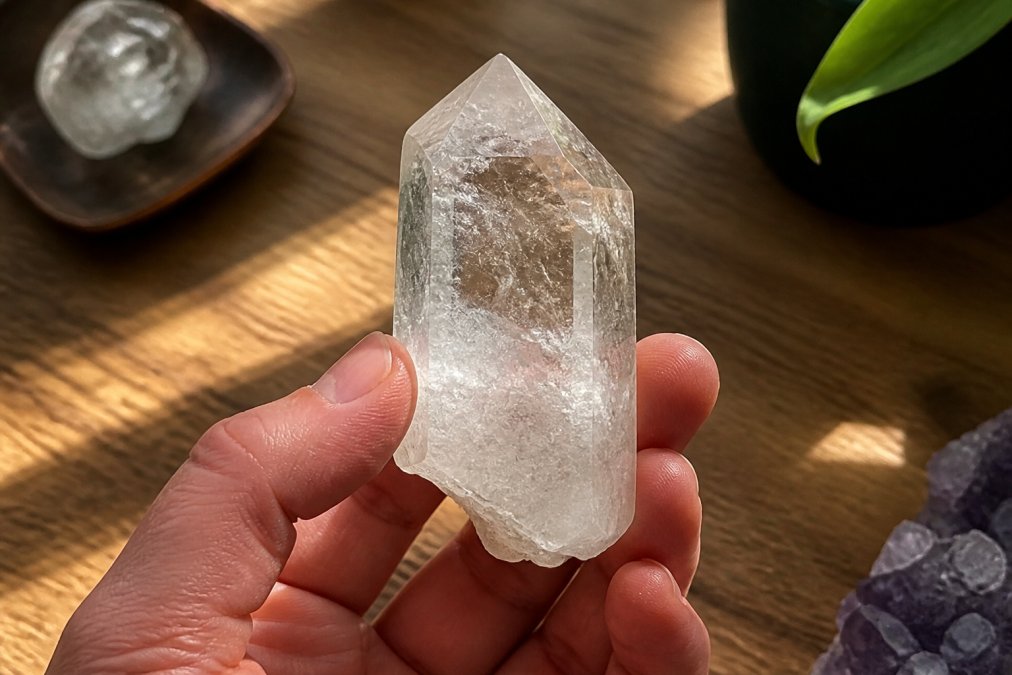
Asymmetry, Inclusions, and Natural Fractures
Genuine crystals are asymmetrical. A real quartz point will have faces of slightly different sizes and edges that don't run perfectly parallel. If a crystal looks machine-perfect, treat that symmetry as a red flag.
Internal inclusions are one of the most reliable authenticity markers. These are minerals, gases, or liquids trapped during formation, including rutile needles (golden threads), phantom formations (ghost-like outlines), and chlorite clouds (green wisps). Glass and resin fakes contain perfectly spherical bubble inclusions instead, something no natural mineral produces.
Natural fractures follow the crystal's internal lattice structure, producing flat, reflective breaks at predictable angles specific to each mineral. Random cracks in glass look nothing like this under inspection.
Weight, Specific Gravity, and the Mohs Hardness Scale
Real crystals feel denser than glass or resin counterparts of the same size. Quartz has a specific gravity of around 2.65, while most glass runs lower and resin considerably lower.
The Mohs hardness scale ranks minerals from 1 (talc) to 10 (diamond). Quartz sits at 7, meaning it scratches glass easily and won't be scratched by a steel nail. If a stone supposed to be quartz gets scratched by steel, it's almost certainly glass or resin. According to the Mineralogical Society of America's mineral properties database, hardness testing remains one of the most reliable field identification methods.
How to Test Crystals with a Flashlight (and UV Light)
Hold a stone up to a bright flashlight beam in a darkened room. Natural crystals show internal complexity: fracture planes scattering light in multiple directions, inclusions casting tiny shadows, and zones of varying translucency. Glass transmits light uniformly with a smooth, even glow.
The UV Fluorescence Test
UV fluorescence is a definitive method for identifying many minerals. Fluorescence is the property of emitting visible light when exposed to ultraviolet radiation. Different minerals fluoresce in characteristic colors tied to their chemical composition, something glass or resin cannot replicate.
Calcite commonly fluoresces bright red or orange. Fluorite glows blue or purple. Certain opals emit distinctive green. Glass typically shows no fluorescence or a dull, uniform response.
To run the test:
- Obtain a UV flashlight (shortwave UV at 254 nm is most diagnostic)
- Darken the room as much as possible
- Hold the UV light 2-4 inches from the stone
- Observe whether the stone glows and note the color
A stone that shows no fluorescence isn't automatically fake, as many genuine minerals are non-fluorescent. But a stone sold as fluorite that doesn't fluoresce warrants serious skepticism.
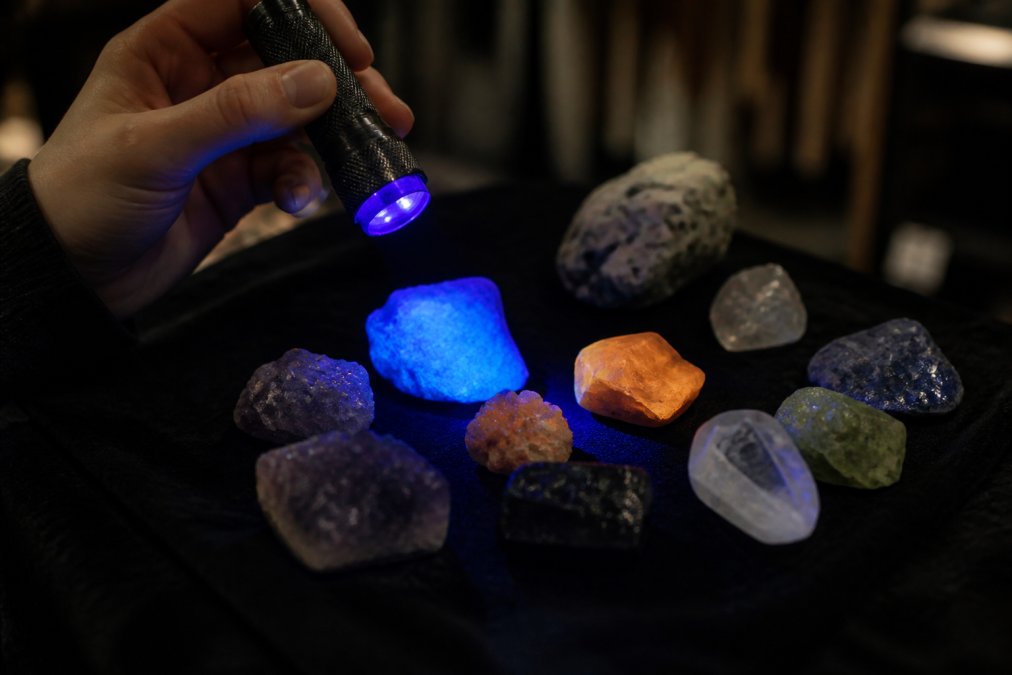
The Gemological Institute of America's gem identification resources provides detailed fluorescence profiles for major gemstone varieties.
Temperature, Sound, and Thermal Conductivity Tests
Thermal conductivity is the rate at which a material transfers heat. Real crystals, especially quartz, conduct heat away from your skin faster than glass or plastic. Hold a suspect stone against your cheek or hand. A genuine crystal feels noticeably cool and stays cool for several seconds. Glass warms up faster; resin almost immediately.
The sound test works best with multiple stones of the same type. Hold two pieces loosely and tap them together gently. Genuine crystals produce a clear, high-pitched clinking sound with resonance. Resin fakes produce a dull, flat thud.
How to Spot Heat-Treated Crystals and Artificial Dyes
Heat treatment and artificial dyeing are the most common misrepresentations because they involve real minerals altered to improve appearance.
Citrine is the most frequently misrepresented stone. Natural citrine is rare and pale yellow. Most sold as citrine is actually amethyst or smoky quartz heated to 470-560°C, converting purple or gray to orange-yellow. Heat-treated citrine shows unnatural orange concentrated at the tips with a white base. Natural citrine tends toward pale lemon-yellow with even distribution.
Turquoise substitutes include howlite dyed blue-green (scratches easily, dye bleeds), magnesite with similar dyeing, and plastic composites. Rub the stone with a cotton swab dampened with acetone. Dyed stones transfer color; genuine turquoise will not. Natural turquoise shows color variation along veining; dyed howlite shows color pooling in pores.
Heat-treated stones often display crazing, a network of fine surface fractures from rapid temperature change. This is visible under a loupe.
| Stone | Common Fake | How to Spot the Fake |
|---|---|---|
| Citrine | Heat-treated amethyst | Orange tips, white base; uneven color |
| Turquoise | Dyed howlite | Dye transfer on cotton; uniform color |
| Lapis Lazuli | Dyed jasper or sodalite | No pyrite flecks; color bleeds |
| Malachite | Dyed marble or resin | Perfect banding; no crystalline texture |
| Moldavite | Green glass | No lechatelierite; too uniform |
| Amber | Copal or plastic | Floats in saturated salt water; melts easily |
Common Fake Crystals List: The Most Frequently Counterfeited Stones
Moldavite is one of the most counterfeited stones due to high value and demand. Genuine moldavite is natural glass from a meteorite impact 15 million years ago. It contains lechatelierite and shows characteristic wrinkled surface texture. Fake moldavite is uniform green glass without internal flow structures.
Lapis lazuli should contain visible pyrite flecks and calcite veining. Dyed jasper or sodalite imitations look uniform and lack the metallic pyrite matrix.
Opalite is man-made glass, not inherently a scam if labeled correctly, but frequently sold as "sea opal" or "moonstone" to imply natural origin. Genuine moonstone shows adularescence, a floating blue glow that moves with light angle. Opalite shows static, milky iridescence.
Obsidian fakes are common black glass. Real obsidian has conchoidal fracture patterns and subtle flow banding visible under strong transmitted light.
How to Identify Fake Crystals at the Microscopic Level
A 10x loupe is the minimum tool for serious authentication. A 30x or 60x jeweler's loupe or basic digital microscope reveals details invisible to the naked eye.
Bubble Inclusions vs. Natural Mineral Formations
Under magnification, the distinction between glass and genuine crystal becomes unambiguous. Natural mineral formations produce irregular, complex inclusions. Rutile needles are elongated and straight. Phantom zones are layered and diffuse. Fluid inclusions form irregular pockets with visible liquid and vapor bubbles that move when tilted.
Glass inclusions are almost always spherical, forming during cooling of molten glass with no geological analog. A stone with multiple perfectly round bubbles is glass.
Chemical Composition Verification
For significant purchases, chemical composition verification is the most definitive test available. X-ray fluorescence (XRF) spectroscopy identifies elemental composition non-destructively within seconds, revealing whether a "turquoise" is actually howlite or a "moldavite" is ordinary glass.
Refractive index measurement with a refractometer measures how much a stone bends light. Every mineral has a characteristic refractive index. Quartz has 1.544-1.553 and shows birefringence (double refraction). Glass has a single refractive index with no birefringence. This single measurement separates genuine quartz from glass conclusively.
According to the American Gem Society's laboratory standards for gemstone identification, professional gemological testing is the only method providing legally defensible proof of authenticity for high-value specimens.
Ethical Sourcing as an Authenticity Signal
How a crystal was sourced is one of the strongest signals of whether it's genuine. Suppliers who invest in responsible mining relationships and maintain documented supply chains have no incentive to substitute fakes. The documentation itself is authentication.
Conversely, the cheapest supply chains with no traceability are exactly where counterfeiting thrives. When a seller cannot tell you which country a stone came from, that opacity should concern you.
What to ask a seller before purchasing:
- Can you tell me the country and region of origin?
- Do you work directly with miners or through a verified intermediary?
- Has this stone been tested or certified for authenticity?
- Are any treatments disclosed in the listing?
CrystalCloud Company sources crystals through verified suppliers with documented origin chains and applies rigorous testing before any stone enters the collection. The Responsible Jewellery Council's chain of custody standards provides a framework for what traceable sourcing documentation should look like.
A seller who answers sourcing questions with specificity has almost certainly handled genuine material. A seller who deflects deserves more scrutiny, regardless of how beautiful the stones look in photographs.
Identifying fake crystals requires combining physical observation, simple home tests, and understanding how genuine minerals form. The tests covered here, from hardness and thermal conductivity to UV fluorescence and microscopic analysis, give any collector a reliable toolkit. For rarer or higher-value specimens, professional XRF or refractive index testing removes remaining doubt. CrystalCloud Company offers ethically sourced, authenticated crystals with verified origin documentation, so you can build your collection with confidence. Explore the Collection and find specimens that are exactly what they claim to be.
Frequently Asked Questions
How do I tell if a crystal is real or fake at home?
Start with the temperature test: hold the stone for 30 seconds. Genuine crystals like quartz stay cool longer than glass or plastic because of their natural thermal conductivity. Then shine a flashlight through it, real stones show irregular inclusions and fractures, while glass imitations often reveal uniform bubble inclusions. A UV light test adds another layer: many authentic minerals fluoresce in predictable patterns tied to their specific mineral composition, whereas dyed glass rarely does.
What crystals are most commonly faked?
Citrine, turquoise, moldavite, and opalite top the common fake crystals list. Citrine is frequently just heat-treated amethyst with an artificially orange hue. Turquoise is often dyed howlite or plastic resin. Moldavite is widely counterfeited with green glass. Opalite is a man-made glass sold as a natural gemstone. Clear quartz and selenite are also replicated in glass or resin, making thermal conductivity and inclusion tests especially important for these stones.
Can you test crystal authenticity with water?
Water alone is not a definitive test, but specific gravity measurement, which uses water displacement, is a legitimate mineralogy method. A stone's specific gravity is its weight compared to an equal volume of water. Genuine quartz has a specific gravity of about 2.65; glass sits closer to 2.5. While the difference is subtle without precision scales, noticeably light stones for their size often indicate hollow resin or low-density glass imitations rather than authentic mineral specimens.
How can I verify a crystal isn't heat-treated or artificially colored before buying?
Ask your seller for documentation of origin and any treatment disclosures. Heat-treated crystals often show unnatural color gradients, citrine that is heat-treated amethyst tends to have a white or cloudy base with an abrupt orange top. Under a loupe or magnifier, artificially dyed stones may show color concentrated along surface fractures rather than distributed evenly through the crystal lattice. Reputable sellers who prioritize ethical sourcing will disclose treatments upfront rather than obscuring them.